The short version
- A waterproof camera travels your drain line and shows roots, breaks, bellies, and buildup live.
- You watch the same monitor the technician watches. No report to wait for, no taking our word for it.
- Drain camera inspection in Dover, PA for repeat clogs, real-estate purchases, and pre-jetting checks.
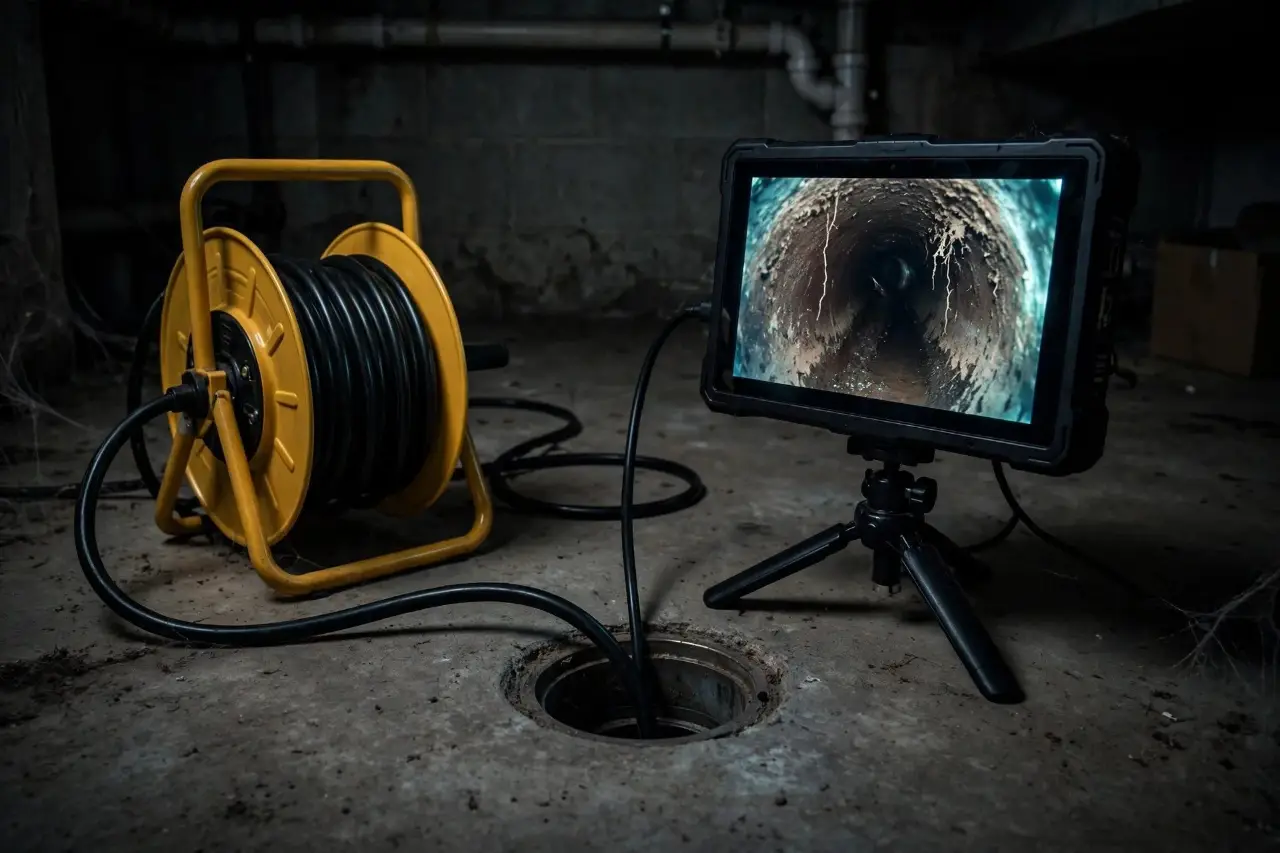
A drain camera inspection in Dover, PA sends a small waterproof camera down your drain line on the end of a flexible cable, and the picture comes back live on a monitor. Roots look like roots. A break looks like a break. There is no interpretation required and no sales pitch attached to the footage; what the camera sees is what the line is.
Most drain work is done half-blind: the technician feels the cable, reads the resistance, and infers. The camera removes the inference. It is how a repeat clog finally gets an explanation, how a homebuyer sees what they are buying, and how a jetting job gets its before-and-after proof.
When a drain camera inspection in Dover makes sense
The clearest case is the repeat clog. A line that has been cleared twice and clogs a third time is not having bad luck; it has a condition. The camera finds the condition: a root mass at a joint, a belly holding water, an offset where the pipe shifted, a section of heavy scale. Each one points to a different next step, and guessing between them is expensive.
The second case is before jetting. High-pressure water should never enter a line whose condition is unknown, so the camera goes first and the jetter follows only if the pipe is sound. The third case is a real-estate transaction, covered below. The fourth is simple curiosity with a purpose: an older home with an unknown line, inspected once, gives you a baseline for every future decision.
What the camera does not do is clear anything. It is a diagnostic tool, usually paired with clearing on the same visit. The line gets opened, the camera goes in, and you get both flow and answers in one appointment.
What the video can show: roots, bellies, offsets, cracks, and build-up
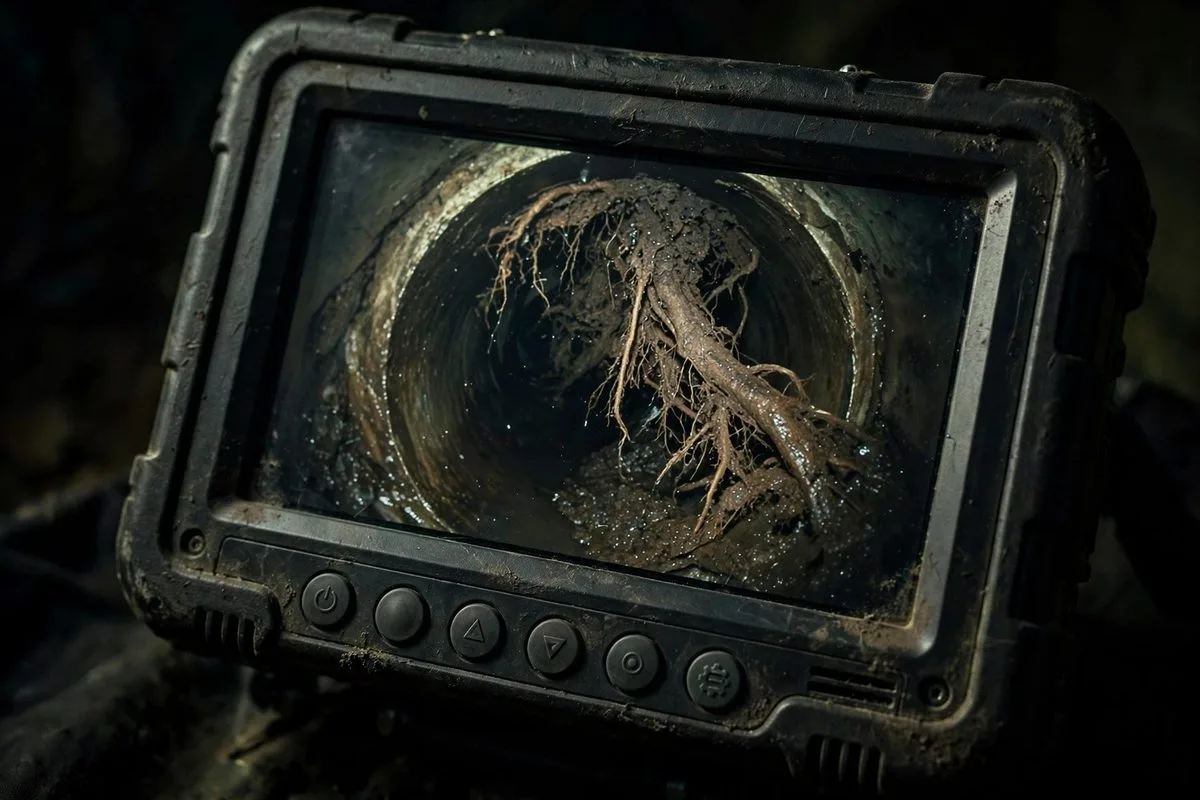
Roots appear as pale, fibrous masses entering at joints, sometimes filling half the pipe. A belly shows as a section where water stands instead of flowing, with the camera seemingly swimming. An offset is a visible step where one pipe section has shifted relative to the next. Cracks show as dark lines, sometimes with soil visible beyond them.
Buildup has its own look: grease coats the walls in smooth, wavy layers; scale crusts them in rough, flaky texture. The footage also shows the pipe material changing along the run, which tells its own story about past repairs. The distance counter on the screen marks how far in each feature sits, measured from the entry point.
You do not need training to read any of this. The technician narrates as the camera travels, pointing out what matters and what is just cosmetic. Most lines have some wear; the question is always whether the wear explains your symptoms.
Finding the exact spot: how a drain line camera locates the problem
Seeing the problem is half the job; finding it from above ground is the other half. The camera head carries a small transmitter, and the technician sweeps a locator wand over the surface until the signal peaks. That point gets marked, along with the depth reading, so the problem has an address, not just a description.
Locating matters most when the fix involves the yard rather than the pipe interior. A break that needs repair, a belly that needs regrading, a root intrusion at a specific joint: all of these are located first so any future work starts at the right spot instead of exploratory digging.
The locate is approximate, not survey-grade, but it is close enough to plan around. For a homeowner, the practical value is knowing whether the problem sits under the lawn, the driveway, or the foundation, because that changes everything about what comes next.
Inspection after repeat clogs: why a video pipe inspection ends the guessing
There is a particular frustration to paying for the same clearing twice. A video pipe inspection breaks that cycle by converting the clog from a recurring event into a visible condition. Once you can see the root mass, the belly, or the scale, the conversation changes from when to clear it again to what to do about the cause.
Sometimes the footage brings good news: the line is sound, the clog was debris, and a thorough clearing plus a change of habits is genuinely enough. That answer has value too, because it stops the worry. Either way, the third visit becomes a decision instead of a repeat.
Bring the history when you call. Which fixtures clog, how often, what the last clearing found: all of it helps the technician know where to look first and what the camera is most likely to confirm.
Buying a home in Dover: why an inspection helps first
A standard home walkthrough cannot see the drain line. The sinks run, the toilets flush, and everything looks fine, while roots quietly fill a clay joint forty feet from the foundation. A sewer camera inspection before closing shows the line you are actually buying, and that information belongs in the negotiation, not in a surprise six months later.
The inspection is quick relative to the stakes: one visit, one video, one clear picture of roots, breaks, and bellies. If the line is clean, you buy with confidence. If it is not, you know exactly what you are walking into and can plan the cost into the purchase.
Schedule it with the same urgency as the general inspection. Drain lines do not wait for convenient timing, and a camera booked before closing is worth far more than one booked after the first backup.
Dover homes and cameras: where inspections earn their fee
The borough's older housing stock is the classic camera case: clay and cast iron lines of unknown age, mature trees, and a history of clogs the seller may or may not mention. Buyers looking at borough homes get the most value per minute of footage, because the lines have the most stories to tell.
In Weigelstown and the township subdivisions, cameras mostly investigate repeat clogs rather than purchases. The pipe is newer, but long main runs across big lots give roots room to work, and a line that has been cabled three times deserves one good look. The footage usually shows a single joint doing all the damage.
Around Davidsburg and the newer west-side streets, inspections skew toward pre-purchase and pre-jetting checks. The lines are young, but bellies from settling and construction debris left in the line both show up on camera, and both are easier to address when found early. we connect you with pros who cover drain cleaning in Conewago Township and drain cleaning in Weigelstown with the same camera on the truck for every call.
Dealing with a clog that keeps returning? Ask about same-day availability and request the camera. Seeing it beats guessing for the third time.
While you wait: before the tech arrives
Buying a home and need the line checked before closing? Check availability in Dover. Pre-purchase inspections get scheduled around your timeline.
Drain camera inspection questions from Dover homeowners
The inside of your drain line on a live monitor: roots, bellies, offsets, cracks, scale, and grease buildup, with the distance marked in feet. You see the condition of the pipe itself, not just the clog. That picture is what turns guessing into a plan.
Yes. The monitor sits where you can watch, and the technician narrates what you are seeing as the camera travels. There is no separate report to wait for; the inspection happens in front of you.
Yes. The camera head carries a transmitter, and a locator wand above ground picks up its signal and marks the spot and depth on the surface. When a problem needs digging or a spot repair, the mark tells the crew where to start.
For many buyers, yes. The drain line is one of the few expensive systems a standard walkthrough cannot see. A camera shows roots, breaks, and bellies before you own them, which is useful information to have during negotiations.
It depends on the length of the line and what the camera finds along the way. When you call, the technician can talk through what the visit usually involves for a line like yours. Most of the time is spent looking, not setting up.
It usually enters through a cleanout, which gives the straightest run. If there is no cleanout, the toilet can be pulled to create access. The technician picks the entry point that gets the camera where it needs to go with the least disruption.
The technician shows you the footage and explains what it means in plain terms. If the line is broken beyond what clearing can fix, we can point you toward a local sewer contractor for repair options.
Often, yes. A camera cannot see through a solid blockage or standing sludge, so the line is usually opened first. Sometimes the camera goes in first to identify what the clog is. The technician decides the order based on what the line is doing.
If the camera shows a line that needs urgent attention, emergency drain cleaning help is answered around the clock. And when the trouble is a low basement drain rather than the main, floor drain cleaning covers that end of the house.
Drain camera inspection in Dover, PA: see it before you fix it
Call Dover Drain Cleaning Co. at (717) 297-8227 for a drain camera inspection in Dover, PA. Watch the footage live, know exactly what your line needs, and stop paying for the same clearing twice.
Calls answered 24/7