The short version
- Several fixtures backing up together means the main drain line, not one sink or tub.
- We work through the cleanout with root-cutting cable or a jetter, then camera-check the line.
- Main drain line cleaning in Dover, PA with priority where available when water is coming up.
When several fixtures back up together, main drain line cleaning in Dover, PA is the call to make. The main line is the single pipe that carries everything from the house to the sewer, and when it restricts, the symptoms show up everywhere at once. This page explains how to recognize it, what the technician does about it, and what to do in the minutes before help arrives.
A main line problem, and the main line drain cleaning it calls for, is a different job from a fixture clog, with different equipment and different stakes. Do not run a small hand snake down the main line yourself; without a cleanout and the right cable, it is easy to get stuck or to push the blockage tighter. The safe move is to stop using water and call.
Signs it is the main line, not one fixture: multiple drains backing up
The pattern is the diagnosis. One slow sink is a branch problem. Multiple drains backing up, toilets gurgling when the washer drains, water rising in the tub when you flush, or the basement floor drain coming up while upstairs fixtures run: all of that points to the main line. The lowest drain in the house almost always shows it first.
Listen for gurgling across fixtures, and watch for water appearing where it should not be. A toilet that bubbles when the shower runs is air trapped by a downstream restriction, escaping through the nearest opening. These signs tend to arrive together and worsen together, because they share one cause.
Sewage smells from several drains at once are another signal. A single dry trap smells local. A house-wide odor that comes and goes with water use suggests the main line is holding water it should be carrying away. Describe the full pattern on the call; it tells the technician exactly what equipment to bring.
The cleanout: where it usually sits in Dover homes
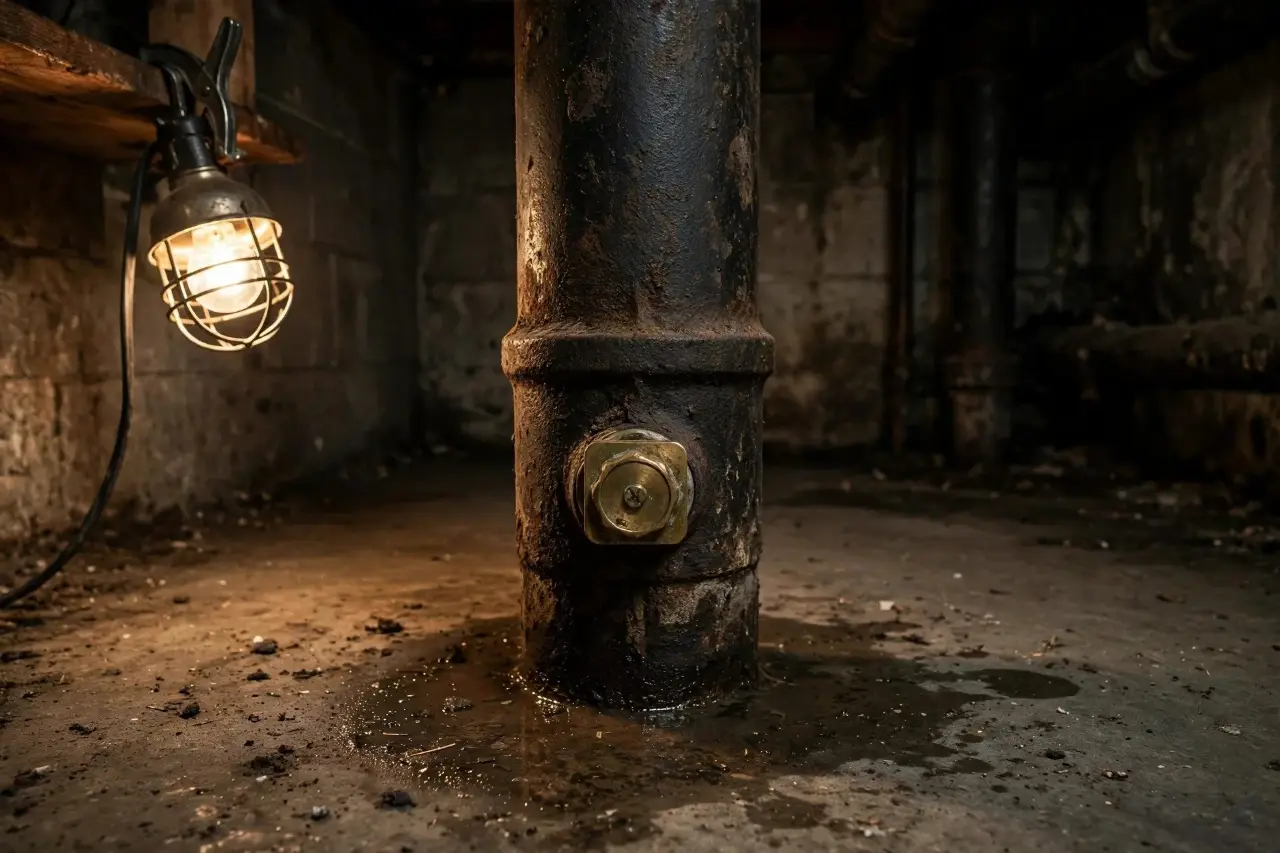
The cleanout is the access point built for exactly this job: a capped pipe that opens directly into the main drain line. In most Dover homes it sits in the basement, where the main leaves through the foundation wall. Look for a capped pipe rising from the floor or a cap on the wall near where the stack exits. Some homes have an exterior cleanout, a capped pipe in the ground near the foundation.
Working through the cleanout is faster, cleaner, and more effective than any other access, because the cable enters the line past all the fixture branches and runs straight at the blockage. If you know where yours is, say so on the call. If you have never found one, the technician will locate it or set up through another large opening.
After the visit, remember where the cleanout is. Every future drain call goes faster when the access point is known, and a visible, reachable cleanout is one of the most useful things a homeowner can have.
Main drain line cleaning with a cable: how a main sewer line clog gets opened
A main sewer line clog is opened with a sectional or drum cable far heavier than anything sold for home use. The technician feeds the cable through the cleanout and works it downstream, letting the rotating head chew through roots, grease, and compacted paper. The feel of the cable tells an experienced hand what it is cutting through.
Different heads do different work: a boring head opens a path through a solid blockage, a root-cutting head shears off intrusions, and a retrieval head pulls back rags and debris. The technician reads the resistance and switches heads as the line dictates. After the line opens, water is run at full flow to confirm it carries.
For lines coated along their whole length, hydro jetting follows the cable: high-pressure water scours what the cable only pierced. The combination, cable first and jetting after, is how a badly neglected main gets truly clean rather than merely open.
Tree roots and older pipe: what we find in Dover
Roots do not break into sound pipe; they find the openings that are already there. Clay pipe joints, of which Dover's older homes have many, shift microscopically over the years, and each tiny gap leaks moisture that roots can sense. A root hair enters, thickens, and becomes a net that catches everything the line carries.
Cast iron brings a different failure: internal scaling and corrosion that roughen the line and narrow it from the inside. The pipe looks intact from outside while the working diameter shrinks year by year. Grease from the kitchen and paper from the bathrooms then have far less room to pass.
Root cutting clears the intrusion, but the joint or crack that admitted the roots remains. That is why a camera check after clearing matters: it shows whether the line is sound or whether roots will be back on a schedule. Clearing is maintenance; the camera tells you what you are maintaining.
When a drain camera inspection is the next step
Clearing opens the line; the camera explains it. After a main line is cleared, a drain camera inspection shows roots, bellies, offsets, cracks, and buildup on video, with the distance marked so the problem spot can be located from above ground. You watch the same monitor the technician watches.
The camera is especially worth it after repeat main line backups. A line that backs up twice in a season has a cause, and the cause has a location. Guessing at either one is how homeowners pay for the same clearing three times. The video turns the third call into a plan.
If the camera shows a broken section that clearing cannot fix, the technician can point you toward a local sewer contractor for repair options. That referral is the honest next step when the pipe itself has failed.
Dover homes and main lines: what the tech expects to find
The borough's oldest homes run on clay and cast iron, with mature trees overhead and joints that have had generations to shift. Root intrusion is the standard finding here, and the cleanout, when one exists, is usually in the basement where the main exits the foundation. These are the lines that benefit most from a camera after clearing, because the camera shows exactly which joint the roots are using.
Weigelstown's post-war subdivisions and the township's ranch neighborhoods mostly have newer pipe, but roots do not read plats. A maple planted over the line in 1975 is fully capable of finding a joint in 2026. The mains here tend to be longer, running from the house across bigger lots, which means more joints and more chances for intrusion.
Winter adds stress across the whole ZIP. Freeze-thaw cycles shift soil around buried lines, and deep frost moves pipe that spent the summer sitting still. Cold-weather backups are a real pattern: lines that behaved all summer start acting up once the ground moves. we connect you with pros who handle drain cleaning in Weigelstown and drain cleaning in Dover Borough year round, and main line calls are prioritized where available when water is rising.
More than one fixture acting up? Ask about same-day availability and describe the pattern. The pattern tells us what to bring.
While you wait: before the tech arrives
Water actively coming up? Skip the list and book your drain cleaning visit now. Main line backups are prioritized where available, day or night.
Main drain line questions from Dover homeowners
The signature is more than one fixture misbehaving at once: toilets gurgling when the washer drains, the tub filling while the shower runs, or the basement floor drain coming up. A single slow sink is a branch problem. Several fixtures together is the main line.
In most Dover homes it is in the basement, where the main drain leaves through the foundation wall, often a capped pipe sticking up from the floor or out of the wall. Some homes have one outside, a capped pipe near the foundation. The technician can help you locate it on the call.
The line can still be worked. Technicians commonly access the main through a pulled toilet or another large drain opening. It takes a little longer to set up, but a missing cleanout does not stop the job.
Yes. A cable with a root-cutting head or a jetter can cut roots out of the line from the inside, with no digging at all. Clearing removes the roots; it does not repair a broken pipe, so a camera check after clearing shows what the roots were getting into.
It is the lowest drain opening in the house. When the main line restricts, wastewater has nowhere to go but up through the lowest point it can find. A floor drain that backs up while upstairs fixtures still work is the classic early warning of a main line problem.
Clearing restores flow, but it cannot promise the line will never back up again. Roots grow back toward the moisture, and grease keeps arriving from the kitchen. A camera inspection after clearing shows the cause, which is what lets you plan instead of react.
If wastewater is coming up into the house, treat it as one. Stop using water everywhere, keep everyone away from the backed-up water, and call now. Calls are answered around the clock, and main line backups are prioritized where available.
Yes, if more than one fixture is backing up. Every flush and every load of laundry adds water above the blockage, and it comes back up through the lowest drain. Stop the water first, then call.
Main drain line cleaning in Dover, PA, at the source
Call Dover Drain Cleaning Co. at (717) 297-8227 for main drain line cleaning in Dover, PA. We open the line through the cleanout, camera-check what we found, and explain your options in plain words.
Calls answered 24/7